Tuesday, April 30, 2013
Lauren Rule- Donnie Darko (Movie Blog #5)
Donnie Darko is an interesting movie. For some very strange reason, the protagonist (Donnie) reminds me of my older brother. I don't even know why because he isn't unstable. I liked "Grandma Death", she tells Donnie that the people who live alone die alone. The nickname for the character is very suiting. The warning from the old woman made Donnie question the meaning of life, or if there even was a meaning to life. Death (the concept not the old woman) makes all people question life. Western civilizations have a stronger focus on death and the fear it inevitably comes with. Eastern civilizations are not as concerned with the end of life. I wrote a paper for my Wisdom and Traditions of India class concerning death. Some people use death as a reason to live their lives to the fullest, while others are stifled by death in their lives. Either way death dictates their lives. The theme of death is continued when Donnie is told the world is coming to an end in under 29 days. Donnie finds an outlet to his distress when he begins having visions of time traveling. Similarly to The Jacket, the protagonist is freed from the fear of death by love. Donnie died feeling blissful with feelings of love, no fear. I would also like to note that this movie had an awesome cast (Drew Berrymore, Seth Rogan, Patrick Swayze, and Jake and Maggie Gyllenhall)!

Lauren Rule- Eros (Outside Reading #5)
Eros, as we discussed in class, is romantic love. I found an article about the Greek god of live also named Eros. According to the article, Eros was the mischievous companion of Aphrodite (the goddess of love). I love Greek mythology and find it absolutely fascinating! The myth continues that Eros, who is mentioned to be mischievous but I also suspect he holds a sexual/romantic component because of how we use the word, and Himeros (desire) are the constant companions of Aphrodite. Valentine's Day's mascot, cupid, comes from the myth of Eros; even though Eros is still distinguished from Erotes (cupids). The connection between Eros and cupids in mythology is obvious. Both characters use a bow and arrows to ignite love in the hearts of men (and gods) and they are both often depicted as children. Due to evolution in ancient myths, there are three categories of Eros. The first Eros is from the ancient cosmogonies. The second Eros is from the philosophers and mysteries. And lastly, the third Eros is from the erotic poets. This article was awesome. It had way more information I could dare to ask for about the god Eros. That is why I love Greek mythology. It can get confusing at times, but there is so much detail in fabled characters. We discussed Eros in context with Babett's Feast and briefly Chocolate for Water. The passion expressed in the movies was amazing. The god Eros was known for striking love directly into people's hearts. The high level of passion from the god explains the level of passion released by people infected by Eros (love). And I do mean infected. The passion was transferred through food in the movies. But if you've ever been around a couple (or a person) in love, it can be intoxicating. The happiness emits from them can be infectious. Unless you find in nauseating of course.
Article
Article
Ben Culotta - Chariots of Fire
One of the films I watched this semester was Chariots of Fire. This film is about two very different
men who compete as runners in the 1924 Paris Olympics. Eric Liddell, a serious Christian Scotsman, believes that he has to succeed as a testament to his undying religious faith. Harold Abrahams is Jewish Englishmen who wants desperately to be accepted and prove to the world that Jews are not inferior. In this film they did portray religious and spiritual messages. “Race till the end…it comes from within.” Whether it was running for the Lord or Eric not running on the Sabbath to honor the Lord, each displayed the Christian message. Man was not swayed from his belief and showed great discernment. It was said that God made each of us for a purpose and God made them fast. Therefore, winning is not just fun it is to honor him. I feel as though Chariots of Fire did a good job at portraying a particular Christian message. In some Christian films they go over board in trying to communicate the Christian theme and, as a result, push people away. It is as though they shove it down their throats and make it as if the Christian life is corny! In my opinion, most Christian films do not portray a realistic Christian life or family. It is as if the people are too perfect and no one can sway them. In my life it has been quite the contrary. The Christian life is hard and it takes more than oneself to get through it.
men who compete as runners in the 1924 Paris Olympics. Eric Liddell, a serious Christian Scotsman, believes that he has to succeed as a testament to his undying religious faith. Harold Abrahams is Jewish Englishmen who wants desperately to be accepted and prove to the world that Jews are not inferior. In this film they did portray religious and spiritual messages. “Race till the end…it comes from within.” Whether it was running for the Lord or Eric not running on the Sabbath to honor the Lord, each displayed the Christian message. Man was not swayed from his belief and showed great discernment. It was said that God made each of us for a purpose and God made them fast. Therefore, winning is not just fun it is to honor him. I feel as though Chariots of Fire did a good job at portraying a particular Christian message. In some Christian films they go over board in trying to communicate the Christian theme and, as a result, push people away. It is as though they shove it down their throats and make it as if the Christian life is corny! In my opinion, most Christian films do not portray a realistic Christian life or family. It is as if the people are too perfect and no one can sway them. In my life it has been quite the contrary. The Christian life is hard and it takes more than oneself to get through it.
Ben Culotta - The Passion of The Christ
So this weekend I decided to give The Passion of the Christ a second viewing. If you have not seen it, it is one of the most brutal films you may ever experience, regardless of your personal religious beliefs. Obviously, if you do believe that Jesus Christ is the Son of God, then you'll probably take the film a lot more personally than someone who doesn't share those same beliefs. As i discussed this film with my roommate who watched it with me, he mentioned that he thought the film was one of the most violent he had ever seen. I tend to agree with that sentiment, to a degree. In the history of movies, there have been countless numbers of excessively violent films. The reason that The Passion stands out as so glaringly violent is because it's all directed at one individual rather than a collective group of people. Seeing the brutal onslaught exacted upon Jesus is almost too much to bear. If you have not seen the movie, you're most likely not going to enjoy it, but I believe that is part of the plan. Its attempt is to accurately portray the brutality of Christ's crucifixion.
Patrick Baker - All Blogs Compiled
Patrick Baker - All Blogs Compiled
Class Film #1
Decalogue is an excellent collection of
short films because it forces you to ask questions. Many films provide the opportunity but do not
present the issue in such an upfront fashion.
Decalogue is a collection of
short films based off of the Ten Commandments, but rather than simply
reiterating those religious teachings, it presents moral dilemmas related to
each. I found the first installment,
titled Thou Shalt Not Kill, to be the most interesting.
In it, a boy is devastated after his sister accidentally
dies, partially because of his actions.
Later on, this boy kills a cab driver, but the driver was actually a
fairly notorious criminal in his own right.
The question posed by this particular Decalogue is whether or not it is
more justifiable to kill an evildoer than a wholly innocent person. Decalogue
uses the Jewish technique of midrashim
to make these stories more relatable. Midrashim is a method by which a rabbi
tells stories related to scripture, but rather than simply relating the facts
through narrative, he conveys additional insights and details that might not
immediately be evident from an initial reading.
Decalogue’s usage of this
technique enables the viewer to debate its moral dilemmas on a deeper level.
Class Film #2
Oz:
The Great and Powerful is a prequel to the famous film The Wizard of Oz. Set in the
same world of Oz that L. Frank Baum created many decades ago, it follows the
Wizard’s journey from our world to Oz, his confrontation with the Wicked
Witches and his subsequent acceptance of a position of power and prestige
within the Emerald City. I found the
film’s acting to be fairly good, and I am a fan of James Franco in general, but
other aspects of the film left me disappointed.
For example, its reliance upon CGI made me feel too removed from the
environment for comfort. In addition, it
wasn’t generally well-written. Overall,
it was an entertaining film, but I wouldn’t label it a particularly great one.
Class Film #3
The Jacket tells the story of Jack, a veteran of the Gulf War
who is killed in action but returns to life afterward. This sets up Jack as a sort of Christ figure
from early on in the film. Upon
returning home, Jack helps out two people, a woman and her child, with their
car. He later helps them again, but not
until after he is set up for killing a police officer and locked away in a
mental hospital. Jack is forced to
undergo an experimental treatment in which he is locked in a morgue
drawer while immobilized in a straightjacket. He eventually begins having visions of the
future. This is a clear parallel to
shamanism, a tradition which uses ascetic practices and hallucinogenic drugs to
produce powerful visions.
It soon becomes apparent that the doctor conducting these
experiments has already accidentally killed quite a few patients. Jack sees a vision of his own death, but he
also realizes that through his future sight, he is able to help others. From this point on, he is trying to make the
most of his march toward the grave by assisting as many other people as
possible. Two such people are the woman
and daughter who he helped on the road.
He is able to stop the mother from living such a destructive life, and
in doing so he ensures a better future for both people. Self-sacrifice is the film’s core theme.
Class Film #4
Northfork was a very interesting movie. I
was rather confused until our discussion at the film’s end. I think this is honestly because I was
looking for symbolism on a deeper level than the one on which the film
operated. The film is set in the town of
Northfork, which is due to be flooded in just a few days to make room for a
hydroelectric dam. Several residents of
Northfork have been hired to convince their fellow townspeople to
evacuate. They have been offered
lakefront property upon the reservoir as an incentive. These men refer to
themselves as “Angels,” an ironic reference for an obvious reason.
Another reason for the irony is the
plotline of the child Irwin. He is
terminally ill, and his adoptive parents return him to the church-run orphanage
from whence he came because they do not wish to evacuate with him. The Reverend who cares for him in his final
days places several objects by his bedside.
As Irwin sleeps and drifts closer to death, he encounters several
strange characters with names like “Flower Hercules.” These are in fact real
angels presenting themselves in the form and under the name of the objects in
his surroundings. Eventually, Irwin dies
and moves on with them, around the same time that the town floods. As I watched, I tried to interpret these
characters on a deeper level, but the symbolism was in fact rather
obvious. Perhaps it was my attempt to
discern a deeper meaning or purpose within Northfork,
as I have yet to fully grasp the point of the film. Maybe its only aim is simply to present a
scene.
Class Film #5
Donnie Darko stars a severely depressed teenage boy of the same name. Donnie is visited by a figure in a very dark,
macabre bunny costume who identifies himself simply as Frank. Frank tells Donnie that the world is going to
end, and Donnie makes it his mission to prevent that from happening. As the movie progresses, many people’s lives
fall apart and many others die. At the
film’s end, it rewinds to the beginning, when Donnie narrowly dodged a jet
engine as it fell into his bedroom. At
the end of the film, Donnie instead does not dodge the engine and dies,
supposedly saving the world in the process.
There are many analyses of this
film, but one that I find most interesting is that it illustrates chaos
theory. Chaos theory is the idea that
any action can have consequences that appear to be completely unrelated. For example, a bird flapping its wings in
Germany could cause an earthquake in California. Donnie needed to die to prevent the world
from ending, and while this might seem like a completely random connection to
draw, such are the principles behind chaos theory.
Outside Reading #1
The Zhuangzi has become probably my
favorite work of philosophy during my time at CNU. While I adore many eastern texts, from the
Upanisads to the Bhagavad Gita to the Shobogenzo and beyond, the Zhuangzi
strikes a very personal chord with me. I
don’t self-identify as a Daoist for numerous reasons, but I think many people
would classify me as one. Ultimately
though, I try to recognize the Zhuangzi’s teaching that words and labels are
inadequate, and that it doesn’t matter what I call myself so long as I find my
personal Dao, or “Way.”
Outside Reading #2
After reading quite a few fitness
articles online, I’ve recently started working very hard to get back in
shape. I’ve played sports for my entire
life, including in high school and in college, but I’ve fallen out of my
fitness routine over the past couple of years.
I’ve made a commitment to myself to start up my old workout routine
again, meaning I’ll hit the gym four times a week followed by intense cardio on
two of those four days, rest twice a week and do yoga or some form of
plyometrics once a week on a sort of active rest day. I’ve realized that it’s essential for me to
do so while I’m still young in order to build a foundation of fitness for the rest
of my life.
Outside Reading #3
Going along with the above, I’ve
also started refining my diet to be healthier and more balanced in light of
several articles on nutrition. Growing
up, my mother always served healthy meals, but in the past couple of years I’ve
let my diet slip. The general consensus
is that nutrition is at least 80% of fitness, and I have basically no excuse
for eating poorly since I know good nutrition from bad. To that end, I’ve calculated my caloric and
macronutrient requirements and started cooking 100% of my meals at home. I’ve also decided to cut out alcohol
entirely, at least until I get back in shape.
It’s full of empty calories and is generally very unhealthy. Hopefully with these adjustments I’ll see
progress soon.
Outside Reading #4
For an upper-level night class with
Dr. Rose this semester, we read several texts on the wisdom traditions of
India. One of those to which I had no
previous exposure was The Forest of Thieves and the Magic Garden, a classic
text of Jainism. I was surprised at how
easy to read and approachable it was for an ancient work. It is clearly very well-written. In addition, it taught me that Jainism is
essentially a different response to and revision of Hinduism. There are many similarities between Buddhism
and Jainism, probably because they reacted to the same qualities within
Hinduism.
Outside Reading #5
I recently reread Rhinegold by Stephen Grundy. Grundy is an author who retells classic myths
in more of a novel structure. His works
pay careful attention to the character of the original myths, and sometimes
they espouse the lessons more effectively than the source material because his
books have been written for a modern audience.
Rhinegold is his retelling of most of the Norse Volsunga saga, and it is both well-written and
fascinating. He treats the tales with a
great deal of respect. I also own his
books Gilgamesh and Attila, both worthy additions to his
initial effort.
Personal Choice #1
Several of my friends have been trying
to convince me to go to music festivals with them this summer. While I probably seem to most like the type
to enjoy festivals (and I love going to shows), they’re really not my scene. I think it’s probably because I’m such an
introvert. There’s a general
misconception about introverts that we’re antisocial or dislike people, which
isn’t true. In simple language, the term
refers to how we get our energy.
Extroverts draw energy from being around others, and introverts draw
energy from being alone. At a music
festival, surrounded by thousands of people, I would probably experience
feelings opposite from those of my friends.
Personal Choice #2
I can’t wait for summer weather to
arrive. Unlike most people, I love
working, and every year during the summer I work a 40-hour week. The beautiful weather combined with the
mental benefits I get of being productive and working hard always puts me in a
great place mentally. In addition, I’m
working very hard to get back in shape.
To add to all the above, I have friends who are working alongside me to
all the same ends, be it finding a job or hitting the gym. In school, our lives have little constant
routine because our class schedules change every semester. While I am by no means a fan of a boring
routine, there is much to be said for consistency and establishing a stable
pattern to one’s life. That’s exactly
what I do every summer.
Personal Choice #3
I’m currently in the process of
revising my senior seminar thesis for publication. I’m thrilled that all three of the professors
on my advising committee voted to pass me with distinction, but there is more I
must do to refine my work before submitting it to a conference or journal. I’m just thrilled at the prospect of being
published as an undergraduate. My area
of interest (Daoism and Chinese philosophy) is certainly a small niche, but
that means that there is still a great deal of interesting research to be done. Hopefully my thesis can help the discipline
progress.
Personal Choice #4
The Noland Trail is always a great
place for me to go when I need to de-stress and introspect. For one thing, I love being in nature, and
for another, the peace and quiet of the trail makes it easier for me to think. Much like Thoreau on Walden Pond, I sit on
the edge of Lake Maury and reflect upon whatever happens to cross my mind at
the time. As an introvert, spending time
alone is essential for me, and the Noland provides the perfect setting for me
to do that.
Personal Choice #5
I’ve recently been trying to upgrade
my wardrobe with more professional attire.
People who know me well might find this surprising, as I probably don’t
come off as the type of person to enjoy suiting up. I really like it, however. Even more importantly, though, as a senior
getting ready to graduate, it’s important for me to have the proper clothes for
work. I can’t afford to buy suits at
this time, but I’m trying to buy everything else, from dress shoes to dress
watches. I’m doing this slowly but
surely. I just feel that while a person
shouldn’t live for their image, they should respect it. It’s all about balance.
Ben Culotta - Boston Marathon Reflection
When the devastating news broke about the events that occurred during the Boston Marathon, was immediately glued to social media and my TV. Regardless of how absolutely devastating the stories and images were, I still felt I had to keep looking to know more. But, I couldn’t help but ask myself: “Why?” Why did I want to keep looking up new information and photos when they all were just getting sadder and more horrifying? Why did I feel the need to know every single minute detail of such a sickening event? Why do we as social beings feel the desire to look up and read about such a terrible incident? I feel that we have to realize that as much as we read stories and look at pictures and watch the news we may never fully understand why this all happened. As unfortunate as it may seem, bad things happen to innocent people a lot of the time, and it is absolutely unacceptable and contributes to why our world at times can be so messed up these days. I find it unbearable to think of all the victims never being able to see their friends and family again because of this tragic incident. In the coming weeks, as the world tries to make sense of the events, we must learn from what happened to help influence the future so that something of this nature does not affect us again. Instead of trying to decode the why, we should reflect on the who: both who we lost and who helped save and protect the almost 200 victims. In doing so, we can be reinvigorated with a sense of hope for the future, as the goodness exhibited helps to revive the nation. Be the change that you want to see.
Lauren Rule- Mysticism (Outside Reading #4)
Mysticism is one of those things I always think I understand, but when I try to explain it I really can't. This article helped clear up some confusion. The way each person experiences mysticism differs, but according to the article a person will most likely be touched by mysticism at least once. The idea of mysticism was first used in Eastern culture before it spread into Western society. Mysticism is the idea of a person having a direct experience of religious truth. We discussed mysticism in conjunction with The Seventh Seal. The protagonist sees death and is determined to make a connection with God before his end. Or at the very least he wants a definitive answer about the afterlife. The article infers the possible root on the word, "myein" meaning "to close the lips and eyes, and refers to the sacred oath of the initiates, the mystes, to keep secret about the inner workings of the religion". I think the inference was due to the secretive aspect of mysticism. The experience of a person with God is extremely personal. An individual might want to share his or her experience, but since perception of an event like that would be so individualized another person may not fully appreciate the experience. And those people who become professional mystics are selective with whom they share their knowledge. Since our class was designed to examine religious concepts within movies, we didn't explore the non-religious side of mysticism. Non-religious mysticism is usually experienced through nature, however, a religious experience can occur through non-religious mysticism. The nature type of mysticism dissolves any and all boundaries between an individual and nature. The article notes Goddess religion and witchcraft as such practices. I think it would be really cool to experience mysticism. I am not really a religious person, but the nature version sounds very liberating.
Article
Article
Lauren Rule- Midrash (Outside Reading #3)
I found an article describing the practice of Midrash. During my college career, I did a paper from Professor Thompson about the practice of Midrash. I don't remember too much about it, except that it was usually associated with Judaism. In my paper, I noted Midrash was occasionally used in Christianity. It doesn't seem so crazy to me since Christianity evolved from Judaism, but apparently associating it with Christianity was incorrect. The article defines Midrash as "the designation of a particular genre of rabbinic literature containing anthologies and compilations of homilies". I understood Midrash as commentary to the sacred texts. In the early days, women were not allowed to participate in Midrash and a rabbi was required during the sessions. I found parts of the article very informative, but reading religious text (or about religious texts) has always been difficult for me. There are so many references that I just do not understand, it is a little frustrating. Midrash, it seems, has evolved over time. The interpretations has changed with the culture of Judaism. The article also notes the influence of other religions on Midrash.
Article
Article
Monday, April 29, 2013
Ben Culotta - I Robot
In the film I Robot, I believe there are many religious footprints stamped on this movie. This movie I feel is not about robots at all but rather what it means to be a human being. At one point in the film, Will Smith says to a robot "You are a clever imitation of life, can a robot write a symphony … can a robot take a blank canvas and turn it into a masterpiece?". The robot counters with another question, "Can you?". The point of this exchange is that it's not to show what a human being is. Rather it shows us what makes us a human and that we are created in the image of God.
With their conscience, the robots in this film start to have feelings and everything else that we see in a human. If a machine can be like a human, then cant people act just like machines? In reality, we are more than just machines, even if the theory of evolution is telling us otherwise. God filled us with ‘"divine spark", which these robots will never possess. We have the characteristics similar to that of God. As I mentioned earlier, we are created in the image and likeness of our one true God. In this film, the robots exist in an area in between technology and human.
With their conscience, the robots in this film start to have feelings and everything else that we see in a human. If a machine can be like a human, then cant people act just like machines? In reality, we are more than just machines, even if the theory of evolution is telling us otherwise. God filled us with ‘"divine spark", which these robots will never possess. We have the characteristics similar to that of God. As I mentioned earlier, we are created in the image and likeness of our one true God. In this film, the robots exist in an area in between technology and human.
Steven Watts-Outside Reading
The recent release of the Hobbit has many movie-goers applauding Peter Jackson's new film, while it has left others feelings sick, literally. Jackson made a decision to present the film in 48 frames per second, which is twice the speed of the typical 24 FPS. Jackson's intent was to make the film feel more life life and realistic for the viewers, but instead it left some feeling the exact opposite. I found some articles on this topic that really interested me because of the many varying opinions. It is interesting how such a seemingly small decision can become the number one thing that anyone wants to talk about when speaking about the film. Those who loved it were able to do so because for them, Jackson hit the nail on the head and made it feel more life like. For those who hated it, they felt as if it became a fake and unnatural environment within the film. It is interesting to see how one film style can be translated so differently by the eyes of different viewers.
http://theweek.com/article/index/237247/why-isnbspthe-hobbit-making-some-moviegoers-sick
http://theweek.com/article/index/237247/why-isnbspthe-hobbit-making-some-moviegoers-sick
Steven Watts-Outside Reading
As my part-time job while attending school here at CNU I have worked at a church in Williamsburg as a video editor. I make anything from promo videos to inspirational interviews with congregants, but the one thing that always remains as the most difficult piece of any clip is the music. I decided to do some reading on the use of music in a film to grasp a better understanding of the medium and how it is developed in films. There was an article from the University of Wisconsin-Madison's student magazine that I thought really summarized the use of music in a film exceptionally well. It simply stated, "A films's score can convey emotion or mood, and prepare the audience for what's to come." Using music to set the mood of the film is a very important aspect of displaying the meant context of the film. A depressing scene would feel completely different to a viewer if it had a light and happy score behind it.
http://onwisconsin.uwalumni.com/departments/classroom/lights-camera-music/
http://onwisconsin.uwalumni.com/departments/classroom/lights-camera-music/
Steven Watts-Outside Reading
I recently was reading an article on the different film techniques that film director Alfred Hitchcock employed in the various movies that he made. The thing that I found most interesting to read about was how Hitchcock took ample time to make sure the shot was framed in order to convey the necessary emotion. He says "the emotion comes directly from the actor's eyes". This is a very interesting concept that I was easily able to relate to the films that we viewed throughout the semester in class. The emotions that are conveyed through the character would be nothing if it were not for the way that they were presented by the camera. The camera is not meant to act as a camera, but rather it is there to take on human qualities so that it is able to convey the emotions to the viewing audience.
http://borgus.com/hitch/hitch2011.htm
http://borgus.com/hitch/hitch2011.htm
Ben Culotta - Bruce Almighty
Another film we were able to choose for our final paper that contains a positive religious message is Bruce Almighty. Too often we as humans are selfish and think we know it all. In this film, Bruce, the main character in the film begins blaming God for all the problems occurring in his life. He has a rare encounter and somehow he is given the power of God. At the time, he thinks he was just handed the best gift in the world, when in reality he has no idea what the role of God entails. Bruce keeps up with his selfish ways, but soon his actions catch up with him and he basically loses it all. I really feel this is the way we all can be. We blame our problems on God, when we really need to be seeking him in our time of trouble. God will be there for us if we have faith. To me as a Christian I feel that this films message was approaching a religious message in a great way. The move was humorous, but the message the audience received was so much more. We see Bruce at his lowest point without God, and then see him at his best with his heart full of love and compassion. Selfishness can ruin anything and everything, and Bruce learned that in this film.
Ben Culotta - Field of Dreams
One of the film's we were able to choose from for our final paper was Field of Dreams. Though I did not choose this film, i decided to blog on it due to the religious symbolism I believe is embedded in the film. The appearance of Shoeless Joe, the return of Moonlight Graham, and especially Ray's connection with his father, all are magical in that they become possible because the rules of time and space have been suspended in some way on Ray's field. In my opinion, the voice we hear commanding Ray, is God's voice. Of course, these things happen because of God's direct intervention. The real story of the film is Ray's choice of whether or not to listen to the voice. What the voice is telling him to do is completely crazy, yet in light of this, he chooses to disregard conventional thinking and build the field because he has faith that this is the right thing to do.
In fact, I believe Ray may portray the role of a prophet. His experience is one hundred percent biblical. Like the story of Noah, Ray is told to build something that makes no sense, yet he does it out of faith. Like Jonah, Ray tries to hide from the voice of God, but just cannot. Like the disciples, Ray is required to trust to the Lord. Additionally, every time we hear the voice it almost has if God his testing Ray just as the bible says. All these are important religious symbols that are evident in this film.
In fact, I believe Ray may portray the role of a prophet. His experience is one hundred percent biblical. Like the story of Noah, Ray is told to build something that makes no sense, yet he does it out of faith. Like Jonah, Ray tries to hide from the voice of God, but just cannot. Like the disciples, Ray is required to trust to the Lord. Additionally, every time we hear the voice it almost has if God his testing Ray just as the bible says. All these are important religious symbols that are evident in this film.
PJ Leegan Random Topic... In conclusion
Overall I have thought that this class was very interesting. I do however also think that I will continue to watch movies in a very simplistic way. Although finding symbolism and "deeper meanings" in movies is interesting, I think I will stick to just enjoying them for what they are. I took a similar class to this that discussed the European memory of WWII in movies and it was probably on of my favorite classes but I didn't like how symbolism was pulled from nothing. I thought in this class that all of the symbolism we found was relative to the movie and maybe even intended to be in the movie from the beginning. In that sense I liked the symbolism, relative symbolism not made up abstract symbolism that you could literally distort to mean anything.
Sunday, April 28, 2013
Ben Culotta - Blade Runner
In the film Blade Runner, I believe there are many religions symbols that are present. First, Tyrell has the appearance of a living god from within a pyramid above the clouds. This self-image is reinforced when Tyrell assumes the role of a god by dimming the sun on command. Given the replicants' superhuman abilities, they are created by Tyrell and fall from the heavens (off-world) makes them similar to that of fallen angels. Another religious symbol is how Roy Batty shares many similarities in this context with Lucifer. Like Lucifer, when Roy cannot gain the power he seeks from his creator, he seeks instead to destroy him. A fourth symbol is when Zhora makes use of a serpent that "once corrupted man" in her performance. Also, nearing the end of his life, Roy transitions into a Christ-like figure who provides salvation and saves Deckard. Upon his death, Roy's soul also ascends into the heavens in the form of a dove.
Lauren Rule- Film Techniques (Outside Reading #2)
I found this article detailing the film techniques of a camera. It's obvious that the camera is essential for conveying emotions or setting the scene. The position of the camera determines what exactly will be in the shot. The 'extreme long shot' has more focus on the landscape or architecture. Characters are usually tiny in this shot to keep the focus on the background or scenery. It is good for some action shots. The pan of the landscape in Northfork appeared to be an extreme long shot. It showed the mountains and the abandoned town. The 'long shot' will show large details on architecture, but it will also show people (closer than the extreme long shot and usually their full bodies). This view can still show action, but will also display groups of people and architecture. I feel like long shots are often used. Ed Bloom and the giant leaving town in Big Fish is an example of it. The 'medium shot' emphasizes the people. It will show small groups (2-3 people) usually from the waist up. During Groundhog Day when the producer, cameraman, and host are waiting for the groundhog to come out the camera probably used a medium shot. A 'close-up' focuses on the facial expressions of the characters. The head and neck of the character(s) will normally take up the entire frame. A scene focused on the conversation would use this. In Blade Runner, when the blade runner and the robot girl are having an intimate conversation the close-up shot was probably used. The final view is 'extreme close-up'. This is used to create more focus on one facial feature of the character. The perfect example for this would be in The Jacket when Jack confronts Dr. Becker in the future. The camera frames Jack's mouth and Dr. Beck's eyes. The shot alternated between the two. Next the article talks about transitions. The abrupt transition from one scene to the next is the most common form. Another type is called 'wipe' where the frames wipes across the replacing the previous scene. One of my favorite techniques is what the article refers to as 'depth of field effects'. The object which requires the attention of the viewer is put in focus while the other objects are out of focus. I like this effect because normally the important objects are in frontal view with the other objects blurry in the background. Sometimes, however, the important object is in the background and the front objects are blurry, I find that to be very cool.
Article
Article
Ben Culotta - Northfork
After watching the film Northfork, I believe there are many spiritual references contained in the film. First, Walter, Willis, and the other government evacuators believed they were earthbound angels helping the townspeople to “fly to higher ground.” They presented a pair of white wings as a gift to those people who agree to leave which supports this point. Also, Walter carries a Jesus crucifix hanging on the mirror of his black government car. At another point in the film, Patsy Cline sings about Jesus in “A Closer Walk with Thee.”
In my opinion though, Northfork lacks much point to its plot. At first, it seems that Irwin is just having a dream about the angels, but this possibility is nullified when Walter and Willis eventually visit the same house, and Walter has a brief vision of the four angels. The film seems to have a lot to do also with the subject of death. Except, however, for Father Harlan’s comment near the end of the film where he says he is no longer afraid of death. It’s hard to know what exactly the movie is trying to say about the subject. Perhaps the filmmakers just want their movie to be experienced rather than interpreted.
Lauren Rule- The Jacket (Movie Blog #4)
The Jacket was a really good movie. I love Kira Knightly so I was really excited about this movie. Jack was a Gulf War vet with extremely bad luck. He gets killed in action during the war, but miraculously comes back to life. Jesus Christ died for his cause and was resurrected to finish his work. Jack, on the other hand, did not find his purpose until after his first death. He helps out a mother and daughter with their car. The mother is clearly unstable, but the young girl is sweet. Jack's bad luck is just beginning when he accepts a ride from the wrong person. He is framed for the murder of a police officer and is sentenced to a hospital for the criminally insane. Jack is neither a criminal nor insane. He has some brain damage from his fatal injury which leaves gaps in his memory, but he is not insane. Stuck in a horrible situation, Jack makes a friend in the asylum. The man claims he murdered his wife when really she left him and he nearly starved himself to death. One of the doctors in the hospital uses Jack as an guinea pig for his experiments. He locks him up in a straight jacket in a morgue drawer. Jack hallucinates visions of the future. All the previous subjects died during the process, except Jack's friend. His friend was undergoing 'treatment' until the other doctor began to worry about his treatment. It seemed the doctor killed them; he tried to save these men then became their executioner. The past mistakes of the doctor haunt him, forcing him to turn to God. When Jack goes back to try and find out how he died; it seemed everyone he tried to talk to was somehow touched by him. This is another parallel with Jesus. Jack experienced a spiritual journey facilitated by time traveling. In shamanism, it was the drugs which brought visions to help others. In this case, however, Jack associated his visions with the jacket. He was also injected with drugs so I'm not sure if it really was the jacket or not. In the end, he changed the life of the woman he really cared about, Jackie. I don't know if he would have died anyway, but he cracked his head after delivering the letter to Jackie's mother. It's plausible he wouldn't have had to worry about his death if he wasn't concerned with Jackie's happiness. Jack, like Jesus, sacrificed his own life to help the lives of others.
Ben Culotta - Donnie Darko
In the movie Donnie Darko, i believe Donnie could portray the role of a superhero. The first instance where this is seen in the film is when Gretchen says, “Donnie Darko, what the hell kind of name is that its like some kind of superhero or something,” and Donnie answers, “what makes you think I’m not.” This conversation occurs right before Donnie is commanded via his "hallucinations" to bust the schools water main, which he does with a simple axe. This may be a sort of stretch, but doing that requires great strength (superhero) however, not impossible. As the investigation into the water main break undergoes, Donnie enters a bathroom only to find that another of his classmates accusing Donnie of blaming him for the vandalism. His classmate proceeds to pull a knife on Donnie, yet Donnie doesn’t even flinch and is completely unaffected by the incident. To me, this means that Donnie is crazy or simply not afraid because he knew he would not be harmed kind of like a superhero. Additionally, Donnie has the ability to see the future, which is power that mere humans can not do also reenforcing the point of Donnie being a super hero. Furthermore, when Donnie burns down Jim’s house it is not shown what he uses to ignite the blaze, could it be that Donnie can create fire in some fashion? All these are examples of why Donnie Darko could portray the role of a superhero.
Ben Culotta - Supernatural
The show Supernatural is about two brothers that are called “hunters”, which means they hunt ghosts, demons, monsters, and investigate any other paranormal activities. Supernatural airs on Friday nights at 9 p.m. EST on the CW Network and Monday through Friday at 10 a.m. and 11 a.m. EST on TNT. This show has six seasons and is currently airing its seventh season. The genre is supernatural/drama. I believe this show targets just about anyone from people in their mid-teens to individuals in their late 30’s. The show's content rating changes per episode, but it’s mostly MA, for mature audiences. Before I watched the show I was a skeptical, and thought that I would not like it. After watching a few episodes, I was hooked. It deals with all aspects of the paranormal and is funny and very appealing. Since watching this show, I believe I have become a sort of addict. The two main characters are Sam (Jared Padalecki) and Dean Winchester (Jensen Ackles). This show was not boring all, and it brings character and humor as well as run of the mill stories about ghosts, demons, and vampires. I highly recommend seeing the show at least once. Some may not like it depending on what genre you enjoy, though I believe some may become fans as I did.
Misc 5 - Stephen Mason
Pre-Columbian Evidence of Axis-Mundi
One thing that I noticed appeared
all over the place in my pre-Columbian class was the amazing amount of
references to the Axis-mundi in the sculptural and ceramic work of the many cultures
that represent pre-Columbian art. As everyone is probably already aware, the
Axis mundi is described as a connecting place between the the world of humans
and the world of the divine and meets at the intersection of the four cardinal
directions. This idea is replicated in many different mediums and forms
throughout the pre-Columbian world, most strikingly in the construction of
pyramids, such as those constructed at Teotihuacan and Tikal. These radial
buildings that have stairs on each side, typically line up with the four
cardinal directions, with the center acting as the axis mundi. The axis mundi
motif is also emulated in pictorial representations in codex’s and on many different
thrones of rulers around Mesoamerica as a way to link the ruling individual to
the authority of the divine. Because of the frequency with which we find these motifs
of the axis mundi around Mesoamerica, linking humans to the divine must have been
an important aspect of ritual life, that would have helped to ensure safety
and well-being.
 |
| Chichen Itza - Maya |
 |
| Folio 1 of the Fejervery - Mayer - Aztec |
Misc 4 - Stephen Mason
Ragas to Riches Music Presentation
I thought I would talk a little about the Ragas to
Riches presentation that was done a little while ago in the Freeman center
auditorium. Presenting traditional Indian music within his presentation, Simon
Maxwell-Stewart provided us with the knowledge of the creation and application
of Indian music as it has developed within Indian religion. Music in India has
gone back a long ways, where India has acted as an incubator of many of these
musical styles that have affected many religions in east Asia. One thing that I
found interesting during his presentation was the fact that the same tune was
used in multiple religions and in multiple languages in order to address the
divine. Even people that cannot communicate with each other or follow the
same religion can have understanding of each other through the common musical
scores that they share amongst each other. Music in this instance can help to bridge
the gap between religions and help to foster understanding between individuals
that are typically against one another because of their differing religious
background.
Misc 3 - Stephen Mason
Coatlique Monolith
 The Coatlique Monolith is a stone representation of a
diety that was created by the people of Teotihuacan during the classic period
in Mexico. Representing a very interesting depiction of a female deity for the
people, she is portrayed as having a large serpent like head with a skirt that
is made of snakes and a necklace that is made of human hands and a skull. This technique
for representing female deities as horrifying monsters is common among pre-Columbian
people, and is repeated in sculptural forms all around central and South
America. The main reason that archaeologists and art-historians have identified
for their depiction in this way is to make one fearful of the power of the deity, as well as inspire awe in the viewer. This runs parallel to the idea that we talked
about in class with Rudolf Otto’s Mysterium Tremendum at Facinans that was
coined in his book The Idea of the Holy. In the same way as Otto describes in
his book, these images of deities being both scary and awe inspiring is a
common way of representing them, and is repeated in many different cultures around the world.
The Coatlique Monolith is a stone representation of a
diety that was created by the people of Teotihuacan during the classic period
in Mexico. Representing a very interesting depiction of a female deity for the
people, she is portrayed as having a large serpent like head with a skirt that
is made of snakes and a necklace that is made of human hands and a skull. This technique
for representing female deities as horrifying monsters is common among pre-Columbian
people, and is repeated in sculptural forms all around central and South
America. The main reason that archaeologists and art-historians have identified
for their depiction in this way is to make one fearful of the power of the deity, as well as inspire awe in the viewer. This runs parallel to the idea that we talked
about in class with Rudolf Otto’s Mysterium Tremendum at Facinans that was
coined in his book The Idea of the Holy. In the same way as Otto describes in
his book, these images of deities being both scary and awe inspiring is a
common way of representing them, and is repeated in many different cultures around the world.
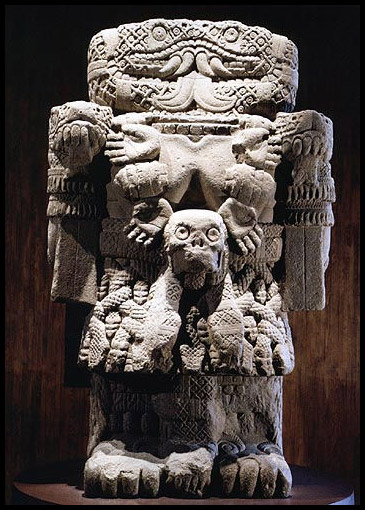 The Coatlique Monolith is a stone representation of a
diety that was created by the people of Teotihuacan during the classic period
in Mexico. Representing a very interesting depiction of a female deity for the
people, she is portrayed as having a large serpent like head with a skirt that
is made of snakes and a necklace that is made of human hands and a skull. This technique
for representing female deities as horrifying monsters is common among pre-Columbian
people, and is repeated in sculptural forms all around central and South
America. The main reason that archaeologists and art-historians have identified
for their depiction in this way is to make one fearful of the power of the deity, as well as inspire awe in the viewer. This runs parallel to the idea that we talked
about in class with Rudolf Otto’s Mysterium Tremendum at Facinans that was
coined in his book The Idea of the Holy. In the same way as Otto describes in
his book, these images of deities being both scary and awe inspiring is a
common way of representing them, and is repeated in many different cultures around the world.
The Coatlique Monolith is a stone representation of a
diety that was created by the people of Teotihuacan during the classic period
in Mexico. Representing a very interesting depiction of a female deity for the
people, she is portrayed as having a large serpent like head with a skirt that
is made of snakes and a necklace that is made of human hands and a skull. This technique
for representing female deities as horrifying monsters is common among pre-Columbian
people, and is repeated in sculptural forms all around central and South
America. The main reason that archaeologists and art-historians have identified
for their depiction in this way is to make one fearful of the power of the deity, as well as inspire awe in the viewer. This runs parallel to the idea that we talked
about in class with Rudolf Otto’s Mysterium Tremendum at Facinans that was
coined in his book The Idea of the Holy. In the same way as Otto describes in
his book, these images of deities being both scary and awe inspiring is a
common way of representing them, and is repeated in many different cultures around the world.Misc 2 - Stephen Mason
Alien Abductions
In my fear and magic class that I am taking through the Anthro department, we talk a lot about magic as a potential reality, and the application of magical practice for many groups around the world. One of the articles that we had to read for the class was on Alien abductions and the religious dimensions of contemporary UFO legends. The article was overall arguing that alien abduction reports follow a lot of religious stories where dieties come down in order to impart on someone special knowledge. The accounts vary from things like aliens warning humans that they are behaving badly and apocalyptic warnings of things to come, to things like identifying a “chosen one” among humans or revealing the identity/purpose of the aliens interacting with humans. All of these elements take a very religious tone in their constructions and function towards imparting a specific person with this special knowledge. Be it from a diety or from something identified as an alien by abductees, both of these entities represent something that is outside and completely unknown to those experiencing the event and are attempting to guide humans down a particular path.
In my fear and magic class that I am taking through the Anthro department, we talk a lot about magic as a potential reality, and the application of magical practice for many groups around the world. One of the articles that we had to read for the class was on Alien abductions and the religious dimensions of contemporary UFO legends. The article was overall arguing that alien abduction reports follow a lot of religious stories where dieties come down in order to impart on someone special knowledge. The accounts vary from things like aliens warning humans that they are behaving badly and apocalyptic warnings of things to come, to things like identifying a “chosen one” among humans or revealing the identity/purpose of the aliens interacting with humans. All of these elements take a very religious tone in their constructions and function towards imparting a specific person with this special knowledge. Be it from a diety or from something identified as an alien by abductees, both of these entities represent something that is outside and completely unknown to those experiencing the event and are attempting to guide humans down a particular path.
Misc 1 - Stephen Mason
Victor Turner - Liminal Rites de Passage
So as a fun class this semester I am taking a class on Fairy
tales from the modern language department. In the third week of class we were
talking about some of the Grimm’s fairy tales and discussing the motif of the
journey. Funny enough, one of the researchers that we talked about was Victor
Turner, who in some way seems to show up in pretty much every class that I
take. Seriously, that guy must be like crazy rich right now with everyone using
his studies. In his discussion of the rites of passage among the Ndembu in
Zambia, he coined the term “liminality”, which involves the entering of a
transitional stage that one has to go through in order to reflect on the morals
and values of society. While we applied liminality in the fairy tale class to
the main characters, typically children, who leave home in order to go on an
adventure before returning back to their normal life, I couldn’t help but relate
the talk on liminality back to our discussion on religious ritual. Through
ritual knowledge imparted through receiving the sacra during the liminal period
in these rituals, greater understanding can be achieved for the initiate. This
liminality acts as preparation for one’s new role in society for both the
children that are depicted in fairy tales, as well as for intitiates in
religious ceremonies.
Outside 5 - Stephen Mason
The Fourth Kind
The Fourth Kind is a movie about
disappearances that occurred in Noam, Alaska in October of 2000. In the movie,
a psychologist named Abigail Adams recalls the story in an interview and talks
about her patients, who believed that they had been abducted by aliens. Using
real footage of the hypnotherapy sessions that were recorded of those that
believed they were abducted, the movie presents the events that happened in
Noam as greatly affecting those that lived in the town. Because of their
inability to cope with the things that they had seen when they were supposedly abducted,
one man ended up taking his life and that of his family. Adams daughter ends up
disappearing at the end of the movie, which Adams believes is because she was
abducted by the aliens that were terrorizing the town. However, because of her
past delusions including the events of her husband’s death, she is questioned
and not many people believe her stories or the footage that they have recorded.
Although the movie was completely panned by
critics, I thought that this movie was actually really good and pretty damn
scary. The supposed footage that they had of people recalling their experiences
and the audio clips that they recorded of the aliens speaking in ancient
Sumerian was really crazy. One of the audio clips that was in the movie that stood
out was when one of the victims asked who the aliens were and they replied “I..am…God”.
Not to mention really creepy, but it also brings up the fact that many alien
abduction stories have religious dimensions to them. In an article that I had
to read for my fear and magic class titled “Religious Dimensions of the UFO
Abductee Experience”, alien encounters often reflect apocalyptic messages, identify chosen people, and revealing the identity of the aliens, which parallels many
religious aspects. Could alien encounters be another interpretation of the
divine and represent an alternative perspective on reality that many religions
seek to claim? I don’t think it is really that difficult of an idea to embrace.
Outside 4 - Stephen Mason
Momento
I know its kinda old now, (seriously after looking up when it was released I felt so old) but I finally got
around to seeing Momento. Overall it was a little confusing but I think I
understand enough to construct a basic plot and commentary. So from what I
understand the main character is Leonard Shelby who is trying to find the man
who raped and killed his wife. The movie is kind of confusing because it seems
to be running backwards rather than following a traditional chronological
narrative. All that he knows about the attacker is that his name is John G. and
that when he finds him he is going to kill him. Because of the fact that he
cannot make new memories because of trauma when his wife was killed, he has to
keep very detailed records of everything that he does so that he can remember
everything. At the end after finding and killing a John G. with the help of a
cop named Teddy, it is revealed that he had already killed the real John G. in
the past with Teddy, and that the new one had to be created so that he could
continue having a meaning to his life. He also ends up realizing that he had
confused elements of Sammy Jankis, which was a case similar to his that he encountered
in the past, and he was the one who most likely killed his wife because of an
insulin overdose. In order to continue to have meaning in his life, at the very
end of the movie he burns the picture of the John G. that he just killed and
takes down the license plate of Teddy, who will become the John G. that he
kills next to continue to give meaning to his life
This movie takes a very existential approach
to knowledge where the individual has to give meaning to his own life, rather than
seek answers from an outside source. For Leonard Shelby, the only reason why he
has continued to keep on living was to get revenge for the man who raped and
killed his wife. Without this driving force, living with his condition would be
incredibly difficult without any thing for him to really accomplish because of
his lack of a short-term memory. His entire defining quality for his identity
at this point is to hunt down and take revenge. Realizing this at the end of
the movie, he chooses to make teddy the new John G. so that he can have a
target with which to define himself.
Outside 3 - Stephen Mason
Mushi-Shi Art Discussion

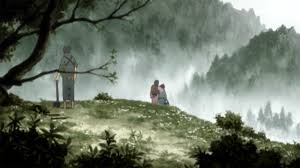


So since I didn't have enough room
in my final paper to include a section on the significance of the art used in
the anime series Mushi-shi, I feel like this blog will give me the opportunity
to address the importance that the art has for the show. The color palate that
is used in the show draws heavily from tones that can be found in the natural
environment, such as the deep greens that are used for the forests and the
varying shades of orange and red that can be found in the colors of the sunset.
Since most of the mushi that are encountered in the show have some connection
to the environment, which again is reminiscent of Japanese Kami in Shinto, the
choice of the series to emphasize these aspects of the show so greatly above
everything else is understandable.
The general art style that is used
throughout the show is heavily influenced by the ink wash painting style that
developed in eastern China. Specific scenes found in the show, including the
representation of the forests that are used many times, have the same hazy
quality to them that many ink wash paintings display. Original ink wash paintings
were unique because of their focus on the capturing of the spirit of the
objects in question, rather than trying to perfectly reproduce their exact likeness
on a page. Similarly in Mushi-shi, Yuki Urushibara is her artwork is attempting
to bring out the inner spirit of the landscapes that she draws into the show in
an attempt to capture the soul of the scenery.

Interconnectedness between the
mushi found within the show and the natural environment is also evident in the
depictions of the mushi themselves. While the shapes that the mushi take are
typically ambiguous, the shapes tend to lean more towards curving organic
lines, which helps to place them within the natural environment of the show.
Because of the way that they are portrayed, believing that creatures such as
these exist is not a difficult thing to consider. Many of the mushi that are
portrayed also blend into the natural environment of the show by taking on the
appearance of plants and animals. Through appearing in the guises of these
organisms, from things varying in range from butterflies to a huge moving
swamp, the mushi are further integrated into the natural environment of the
show.
Outside 2 - Stephen Mason
I finally got around to seeing
Wreck-it-Ralph after seeing the commercials for it on TV and hearing good
reviews from friends who had seen it. So the story centers on Wreck-it Ralph who is a villain in an arcade videogame that wants to turn good. Because of his
habit of destroying things however, the town’s people in his game, Fix-it Felix,
don’t like really like him and force him to live on the outskirts of the town
in a dump. Thinking that if he returns to the town with a hero’s medal that he
will accepted by the town’s people of his game, Ralph ventures into other games
in order to acquire a medal. After locating one in a first person shooter game
in the arcade, he ends up losing it in a candy themed racing game. After
meeting up with a new character and eventually saving the racing game from an
invasion of creatures from another game, he gains new respect from the towns
people of Fix-it Felix and returns a hero.
Ralph’s journey can be seen as a
representation of a liminal state in which he reflects on his own place in the
world and comes to a revelation in the end of the movie when he is
re-integrated back into his place in Fix-it Felix. Through the journey to
acquire a medal that takes him through some of the other games in the arcade, he
is hoping to gain the respect of others by becoming the hero that he thinks everyone
wants him to be. However, as the story progresses Fix-it Felix is almost
unplugged because of the fact that Ralph is not there in the game. At the end of
the movie he realizes that just because he is a bad guy in the game who has to
destroy everything, he is a necessary member of the game in order for it to be
successful. In the same way that destruction is required and can be a source of
creation, Ralph is needed in the game in order to keep balance.
Outside 1 - Stephen Mason
Jiro Dreams of Sushi is a
documentary that I recently saw on Netflix that follows Jiro Ono, a 85 year old
sushi master and owner of the Sukiyabashi restaurant in Tokyo. The documentary
provides an in-depth look into the way that they prepare the sushi in his
restaurant, which has earned them a perfect Michelin score in the food
industry. With plates of sushi costing upwards of $100 a plate, the sushi that
they make is considered to be one, if not the best sushi in Japan. One thing
that is emphasized in the movie is the importance that they give to the product
that they buy, as well as the way that they prepare the sushi ingredients.
While many restaurants when preparing sushi may try and create differing
flavors using sauces in order to appeal to the customer, Jiro’s restaurant
doesn’t do anything special to the fish that they use or the rice that they
buy. Instead of trying to re-invent sushi, they try and make the sushi that
they create as perfect as they can make it, while at the same time upholding almost ridiculously
strict quality standards for the product that they present to the customer.
Everything that is done in the
movie that involves the opening of the shop to the preparation of the sushi can
be considered a very important ritual that needs to be followed in order to
ensure success. When Jiro goes to work in the morning he sits waiting for the
train in the exact same spot every day and sits on the same seat on his ride
over. Opening of the restaurant involves a precise method of cleaning and preparing
for the customers before they arrive. While they likened his sushi making to
art in the documentary, there are specifically proscribed methods to everything
that he does, which his apprentices find it difficult to emulate. Having
performed the same thing every day, having not taken a day off from his routine
but three times in his life, he has perfected his ritual which can ensure his
patrons will receive the same quality every time.
Northfork - Stephen Mason
Northfork, written and directed by
the Polish brothers, follows the story of the town of Northfork, Montana as it
is being prepared for a new dam to be built. Because of the fact that the dam
will cause the entire town to be flooded, people are sent into the town in
order to make sure that everyone leaves there residences and are relocated. A
father and son team that are working for the company that is overseeing the
evictions are the two major characters in the movie who are working towards
acquiring enough evictions so that they can be given a parcel of land on the
banks of the new lake that will be created. The two characters are at odds with
one another over whether to exhume the mother from her grave, which the father
believes is necessary, and the son who believes that his mother’s grave should
not be disturbed. Along with these two main characters, there is also a subplot
in the movie that involves a sick child named Irwin who is being cared for by
the pastor who is one of the last remaining residents of the town. While Irwin is in his bed he has dreams in which he meets an odd assortment of angels, who choose
him as the unknown angel and take him away in an airplane in the end of the movie.
I actually really enjoyed this
movie a lot, even though at times it was hard to follow because of how weird
some of the elements of the movie were. I really liked the way that the director
incorporated the elements from the kid’s nightstand into the angels that he saw
in his dreams. This is actually one of the first times I had actually noticed
the motif in the movie before we talked about it, so I was pretty proud of
myself. Although the scenes with the angels were definitely pretty weird, I
felt that it made sense considering that they were coming from the mind of the
kid, rather than representing people in real life. The scene with the snow in
the abandoned house that was split in two that the father and son team went
into was really well done and definitely showed the disconnect between what the
father and son wanted for the dead mother.
Oz The Great and Powerful - Stephen Mason
Oz the Great and Powerful is a
prequel movie that attempts to provide a back story for the events that occurred
in the original Wizard of Oz that was released in 1939. The movie starts out
with Oscar Diggs, who would later become the Wizard of Oz, being taken away in
a tornado to the Land of Oz. After arriving and meeting Evanora, Glinda, and
Theodora, who would later become the witches of the original throughout the
course of the movie, he attempts to prove to the inhabitants of Oz that he is a
magician. Theodora eventually bites an apple that turns her green, which
signals her becoming the Wicked Witch of the West, and attempts to attack the
Emerald City. Using a mixture of technology in order to frighten her away from
attacking, Oscar is able to repel the attack. From this point on Oscar Diggs,
now taking the title of Wizard of Oz, uses the projector that he used to repel
the attack as his true form, becoming the character that would be encountered
later.
I can’t really say that I am a fan
of these prequel movies, especially given the fact that the original was made
so long ago and has become such a greatly loved classic. Even given the usage
of heavy amounts of CGI that was used in the movie, which did in a away make
the movie a bit better, the movie did not really capture the same aspects of
greatness that made the original so well-received. The original was created
before the heavy usage of CGI and really felt more real and was overall more
entertaining than this movie was to me. I believe that the heavy usage of CGI was really the main draw to the movie, and when coupled with a story that was
kind of difficult to understand at times, made the movie a bit of a wash in my opinion. The
movie was however commercially successful, which I guess is really all that
matters to a lot of producers anyway.
Donny Darko - Stephen Mason
This movie was totally crazy. I
don’t know if I completely understand what was going on in the movie but I
think that I can at least try and come up with some sort of synopsis. So the
main character in the movie is Donnie Darko, who is a teenage kid living in a
small town, who has the ability to see a figure in a rather creepy bunny
costume that calls himself Frank. While most people believe that the visions
that he sees are some kind of psychosis, he tries to change the world
around him in order to heed the apocalyptic warning the bunny gives him.
Throughout the course of the movie many people’s lives end up being destroyed,
and many people end up dieing. In the very end of the movie though, the movie
plays in reverse back to the beginning where Donnie ends up being killed by the jet engine falling into his room that he avoided in the very beginning of the
movie.
I believe that Donnie Darko in
this movie saw the horrible things that occurred because of his actions after
he avoided the jet engine falling through his room. After seeing these events,
I think that he chose to go back to the time when the engine fell into his room
so that he could die, and in effect end up saving the people that were hurt
when he had avoided the engine. In this way he was a sacrifice in order to
secular the lives of the other people in the town, and sacrificed his own
existence in order to prolong theirs. At the point in the end when the vortex
is over top of the town signaling the apocalypses that the bunny had foreseen,
he saw that the only way to save the world was to sacrifice himself by
reverting back to when he should have died from the jet engine.
Exploring Film Techniques - Stephen Mason
I was really a fan of this class,
considering that it was a good break from our established norm of watching full
length movies and discussing their importance in regards to religion. While I
enjoyed all of the short clips that we watched, the movie that stood out to me
the most was the short film Bunny. In the story, an elderly female rabbit is
baking a cake and is being bothered by a moth that keeps flying around in her
kitchen. After finally killing the moth, it falls into the cake batter where
she mixes it up, puts it in a cake pan, and throws it in the oven. After waking
up from a nap, the bunny goes to the kitchen to find the oven glowing. At this
point she crawls inside the oven and is met by many moths all going towards a
great white light. Having grown moth wings herself, she follows them towards
the light.
The oven in this short story acts
as a portal to the afterlife, through which the female bunny can be reunited
with her deceased husband. One of the things that struck me in this film that
we watched was the significance that animation can have on the story telling
process. Like we briefly discussed in class, all elements of an animated movie
are purposefully included by the animator in order to tell the story. Because
of the choice to animate this story we can experience fantastical things, such
as a human sized bunny that crawls into an oven that opens up into a portal
through which the afterlife can be reached. The animators should also be
commended for the emotions that they were able to capture, specifically on the
female bunny, which really helped to connect the feelings of the character to
that of the audience.
Steven Watts-Shamanism
After watching The Jacket in class and speaking about Shamanism, I wanted to take the chance to look a little more into what it really is. After reading a couple of articles, there was one line that really resonated that came from the Catholic Encyclopedia. The line just says, "The main principle of Shamanism is the attempt to control physical nature." In the film The Jacket, doctor uses his form of drug induced hypnosis to attempt to control the mental activity of the patients. "Hence the term embraces the various methods by which the spirits can be brought near or driven away." The movie displays them trying to draw reality into the lives of people who have experienced things in their lives that have caused them to lose sight of reality around them. i thought the idea of putting yourself into your own sort of sleep induced state to alter your reality coincided very clearly with the fil we saw in class. I would have never realized that the movie was connected to many characteristics of Shamanism.
Saturday, April 27, 2013
Film technique
Film Techniques:
During the film "Bunny," we see how the theme is time running out leading to death. The timer during the film shows how time will always end at some point and they used the light from the oven to show how she was wanting to go where her husband was. "Northfork" also had a theme following death. The coffin on top of the car traveling up the mountain symbolizes how death leads into a higher place. Having the mountains in the background also show a peaceful way of rising. "Paris Texas" focuses more on communication. Throughout the entire film there are multiple scenes showing the different ways of communication with other people. "Pink Floyd" is all about war. The animation shows how war creates destruction and it depicts officials poorly. By doing that, it symbolizes how not everyone always knows the right way. "Cabeza de Vaca" show how while the man keeps trying to run away, he ends up right where he started. It shows how even if someone wants to run away from a situation, it doesn't mean ti will always work.
Great and Powerful Oz
The Great and Powerful Oz
This film was something I was truly looking forward to. Being based on one of my childhood favorites, it definitely had a lot to live up to. Since it was a prequel to "The Wizard of Oz," I really liked how they set everything up to where it makes sense how everything happens later in life. Starting the film off with black and white then switching to color really played off the original movie. It helps the audience connect with this film just like they did for "The Wizard of Oz." I also like how they had the "wizard" as a magician. It really shows how he grew to become known as a wizard.
Northfork
Northfork
Northfork was one of the harder films to understand. It was also very sad, especially seeing how the boy was already dying from an illness and then left by his parents in an orphanage. When he starts seeing himself as an angel, to me it showed how good and bad can be divided. It was a way to escape his life, which almost everyone does when we are trying to avoid something.
#2
Decalogue
The first commandment states, "Thou shall have no other God before me." This films shows an example of how we can not allows rely on logic, or another God, to help us find answers. The boy's Father tried to use science to answer all of his questions while the boy's aunt saw things different. Since the boy's Father was so determined that he could calculate the thickness of the ice so his son could go skating. When the ice ends up breaking and the son dies, the father changes his ways and goes to church instead of living his life by science. The whole situation was ironic because the father tried using science to determine a natural state, when realistically no one can completely determine nature.
Friday, April 26, 2013
Steven Watts-Random
I recently read an article about suicide found in teens. After reading this and thinking about the ways that many of these kids dealt with their pain, it brought me back to the movie Northfork that we just watched in class. The boy in the film sought refuge within his own brain from the pains of his own reality. Many of the kids that were spoken about in this article that I read, were faced with real world devastating realities, but found escapes from their lives in things that they could alter their reality with. For many of these kids it was drugs and alcohol, others it was eating disorders, but all of them sought out something. I think it is so easy for us to ignore the people around us and to disregard the realities that they find themselves in. If we are able to realize these things many peoples lives could be changed.
Steven Watts-Northfork
Although there was a lot going on in this film, the thing that I found to be most interesting was the story of the orphaned boy. He found himself amidst one of the worst situations i'm sure he could have imagined to happen in his life. His town was being destroyed, he was dying from a horrible illness, and his parents left him with the local orphanage to die as they fled the town. Although it seemed as if he was not fully aware of what was going on, he knew that it was not a good situation. Because of this, he began to create an alternate reality for himself where he was an angel. I found this to be so similar to many people lives that I have encountered. We often find ourselves in situations that we do not know how to handle, so we find a way to escape from it. For some people it is as innocent as reading, and others it can become using drugs or alcohol. Whatever it may be, it seems as if it is human nature to create these alternate realities in our lives in order to escape from the things that are unbearable in our lives.
Evan Shively-Random Blog OldBoy
The final outside film that I watched that reminded me of the themes we discussed was the Korean revenge film "Oldboy". The film is extremely dark and stylized. The dialogue of the main characters is most often spoken poetry then straight dialogue. The film follows the imprisoned Diago who after 15 years of imprisonment is let go without any explanation. Diago attempts to solve the mystery behind his imprisonment and punish the men responsible. He goes to any length and puts his martial arts skills to the test to gain revenge. One of the major symbols in the films are ants. When imprisoned Diago often has vision of ants that coincide with the drugs we is given. Diago is forced to live a routine trapped in a room for 15 years. He notices the routine that is life and compares the people of the city to so many ants on a subway. The movie reminds me a lot of Blade Runner. It is very dark and distopian. It plays at the notion of what it means to live in a world without any morality. The final scene of the film in which SPOILER Diago decides to erase his memory in order to remove the guilt he felt also reminds me of the film eternal sunshine and the spotless mind.
Evan Shively- Random Blog Sherlock
Sherlock is a modern reinterpretation of the great British detective. It has taken off and become one of the most watched dramas both in Britain and in the US. The episode are often reinterpretation of the books taking place in a more modern context and with modern technology. Each episode is around an hour and thirty minutes and revolves around a series of crimes. The film series has a very small amount of religious themes throughout the film. However, one theme that the show does play at that stood out to me was the notion of purpose. Sherlock's purpose behind his crime solving seems to be mostly for the thrill of the hunt. He is uninterested in the lives of the people and is more interested in using his analytical skills to prove he is the best. Watson on the other hand is always deeply concerned with the lives at stake and places them first. The series reminds me a lot of the seventh seal and the relationship between Blok and the Squire. It is perhaps the opposite but both characters are paramount in each others self discovery throughout the film. It also reminds me of Aristotle's discussion of the goal of friendship as each character seems to work to better each others souls.
Evan Shively- Random Blog House of Cards
Netflix took a dramatic step forward in creating this remake of this british political drama. Released strictly for Netflix the series gives dramatic freedom to the director and plays like a prolonged movie. In the film congressional party whip Francis Underwood runs a victorious campaign for the democratic presidential campaign. However, upon wining he is not rewarded the position he expected from the president. Francis decides to take matters into his own hands and begins political games in order to gain more power. Both him and his wife are willing to sacrifice anything to fulfill their goals. While watching the show their are numerous events when religion shows its face. Underwood uses religion as a tool to gain support, he often lies about his faith. In one episode he goes to a church and prays. Francis states that he prays only for himself and too himself. He seems to be superstitious despite not believing in God. Underwood's faith is placed only in himself and his final end is his success. He does not believe in a inherent meaning to life instead he takes it. Despite being devoid of any faith he seems unable to shake the presence in the possibility of some spiritual realm.
Evan Shively- Random Blog Fourth Kind
When me and my friends were flipping channels back in high school we stumbled upon one of the strangest films I have every seen. The film shows footage that seems like real first hand footage spliced into a dramatization of the events. It follows a psychologist in Alaska who keeps getting clients who have suffered through the same strange experience. The experience in question are alien abductions that they are unable to fully remember. However, when they are hypnotized they begin to recall the events often leading in demonic tramu for the person. What scared us about the film is we did not know that the "first hand" footage was fake, the film does not outwardly tell you and the footage and tapes seem incredibly real. It is an effective technique in drawing the audience into the film. The film begins with the tagline "you choose what to believe". The film itself is mysterious playing a the psychology of the audience in order to determine what is real and what isn't. The film has two major religious themes. The first is the idea of a mysterious other, playing at the human notion of fear of the unknown. The film itself uses the myth of the summering language be created by aliens as a central point. These aliens could have been early Gods for humanity. Humans also create explanations for the unknown such as aliens. The second religious theme is epistemology. What is real and what isn;t is unclear in the film.
Evan Shively- Random Blog Se7en
The movie se7en is an entertaining and extremely dark crime thriller with multiple religious themes throughout the film. Centered around two detectives played by Morgan Freeman and Brad Pitt, the film explores the apathy of the modern world through a serial killer who uses the seven deadly sins as his motif. Morgan Freeman's character is an aging cop close to retirement, who has become burdened by the crimes he has witnessed. He has lost faith in humanity and in the ability for the city to redeem itself. In one part of the film Freeman states that the crimes he solves are simply reporting history for an invisible audience. He is un-optimistic that any of it truly makes a difference. Brad Pitt's character on the other hand is a young and optimistic cop, who believes the killer can be found and stopped. The killer commits crime representing the sins of man, for example, in showing gluttony he forces a man to eat in-till he dies. When the killer is revealed he states that he commits these crimes to reveal the horrible nature of mankind. He wishes to shock the world away from their sinful and apathetic lives. The killer believes that the seven deadly sins run ram-pit in today's society and that no one seems to care. While the killer obviously takes this to an extreme, the film-maker is certainly trying to make a point. In modern society ideas that were once believed to be the deadliest of sins, and harmful to the benefit of the soul according to Aquinas have become common place and even considered virtues. Ideas such as greed are defined as success. Advertisements seem to play on lust and our economy runs on gluttony. It is an interesting religious idea if engaging in these sins or creating a culture that worships them is ultimately harmful to a metaphysical soul.
Evan Shively- Class Readings Bible
Lamentations 3.10
He is a bear lying in wait for me,
A lion in hiding;
he led me off my way and tore me to pieces;
he has made me desolate;
he bent his bow and set me
as a mark for his arrow
This verse in lamentations reminds me of when we watched the seventh seal. The same thoughts that were so prevalent in the days in which lamentations was written is quite similar to the plague that these people must be going through. The faith that they once had was made weak by the amount of pain and suffering they dealt with. Blok feels that God cannot be real after what he has witnessed. The religious feelings of doubt and lamentation are a deeply spiritual matter.
Evan Shively- Class Reading Bhagavad Gita
The Bhagavad is one of the most important and most loved religious texts. Detailing the beautiful love of the God Krishna and the notion of peaceful non-action in details many of the central tenets of Buddhist thought. In the beginning of the story Arjuna stands at the penicle of battle. He awaits to lead his troops into battle. Unfortunately he is torn. The men he is suppose to fight are his fellow people. He does not know what to do, and enters into a deep meditation. While lost in his thoughs he is greeted by the God Krishna. Krishna proceeds to reveal the true of the spiritual nature of man. He puts the notion of divine love as the most high. He states how loved Arjuna is. This creates a reassurance for him, especially this part in particular;
"Thou grievest for those that may not be lamented, whilst thy sentiments are those of the expounders of the letter of the law. Those who are wise in spiritual things
grieve neither for the dead nor for the living. I myself never was not, nor thou, nor all the princes of the earth; nor shall we ever hereafter cease to be. As the lord of
this mortal frame experienceth therein infancy, youth, and old age, so in future incarnations will it meet the same. One who is confirmed in this belief is not disturbed
by anything that may come to pass.
Subscribe to:
Comments (Atom)