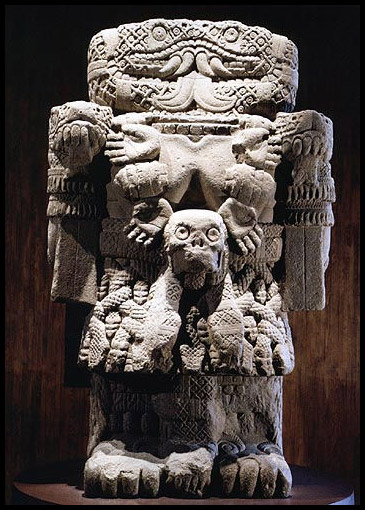
 The Coatlique Monolith is a stone representation of a
diety that was created by the people of Teotihuacan during the classic period
in Mexico. Representing a very interesting depiction of a female deity for the
people, she is portrayed as having a large serpent like head with a skirt that
is made of snakes and a necklace that is made of human hands and a skull. This technique
for representing female deities as horrifying monsters is common among pre-Columbian
people, and is repeated in sculptural forms all around central and South
America. The main reason that archaeologists and art-historians have identified
for their depiction in this way is to make one fearful of the power of the deity, as well as inspire awe in the viewer. This runs parallel to the idea that we talked
about in class with Rudolf Otto’s Mysterium Tremendum at Facinans that was
coined in his book The Idea of the Holy. In the same way as Otto describes in
his book, these images of deities being both scary and awe inspiring is a
common way of representing them, and is repeated in many different cultures around the world.
The Coatlique Monolith is a stone representation of a
diety that was created by the people of Teotihuacan during the classic period
in Mexico. Representing a very interesting depiction of a female deity for the
people, she is portrayed as having a large serpent like head with a skirt that
is made of snakes and a necklace that is made of human hands and a skull. This technique
for representing female deities as horrifying monsters is common among pre-Columbian
people, and is repeated in sculptural forms all around central and South
America. The main reason that archaeologists and art-historians have identified
for their depiction in this way is to make one fearful of the power of the deity, as well as inspire awe in the viewer. This runs parallel to the idea that we talked
about in class with Rudolf Otto’s Mysterium Tremendum at Facinans that was
coined in his book The Idea of the Holy. In the same way as Otto describes in
his book, these images of deities being both scary and awe inspiring is a
common way of representing them, and is repeated in many different cultures around the world.Sunday, April 28, 2013
Misc 3 - Stephen Mason
Coatlique Monolith
 The Coatlique Monolith is a stone representation of a
diety that was created by the people of Teotihuacan during the classic period
in Mexico. Representing a very interesting depiction of a female deity for the
people, she is portrayed as having a large serpent like head with a skirt that
is made of snakes and a necklace that is made of human hands and a skull. This technique
for representing female deities as horrifying monsters is common among pre-Columbian
people, and is repeated in sculptural forms all around central and South
America. The main reason that archaeologists and art-historians have identified
for their depiction in this way is to make one fearful of the power of the deity, as well as inspire awe in the viewer. This runs parallel to the idea that we talked
about in class with Rudolf Otto’s Mysterium Tremendum at Facinans that was
coined in his book The Idea of the Holy. In the same way as Otto describes in
his book, these images of deities being both scary and awe inspiring is a
common way of representing them, and is repeated in many different cultures around the world.
The Coatlique Monolith is a stone representation of a
diety that was created by the people of Teotihuacan during the classic period
in Mexico. Representing a very interesting depiction of a female deity for the
people, she is portrayed as having a large serpent like head with a skirt that
is made of snakes and a necklace that is made of human hands and a skull. This technique
for representing female deities as horrifying monsters is common among pre-Columbian
people, and is repeated in sculptural forms all around central and South
America. The main reason that archaeologists and art-historians have identified
for their depiction in this way is to make one fearful of the power of the deity, as well as inspire awe in the viewer. This runs parallel to the idea that we talked
about in class with Rudolf Otto’s Mysterium Tremendum at Facinans that was
coined in his book The Idea of the Holy. In the same way as Otto describes in
his book, these images of deities being both scary and awe inspiring is a
common way of representing them, and is repeated in many different cultures around the world.
The Coatlique Monolith is a stone representation of a
diety that was created by the people of Teotihuacan during the classic period
in Mexico. Representing a very interesting depiction of a female deity for the
people, she is portrayed as having a large serpent like head with a skirt that
is made of snakes and a necklace that is made of human hands and a skull. This technique
for representing female deities as horrifying monsters is common among pre-Columbian
people, and is repeated in sculptural forms all around central and South
America. The main reason that archaeologists and art-historians have identified
for their depiction in this way is to make one fearful of the power of the deity, as well as inspire awe in the viewer. This runs parallel to the idea that we talked
about in class with Rudolf Otto’s Mysterium Tremendum at Facinans that was
coined in his book The Idea of the Holy. In the same way as Otto describes in
his book, these images of deities being both scary and awe inspiring is a
common way of representing them, and is repeated in many different cultures around the world.
Subscribe to:
Post Comments (Atom)
No comments:
Post a Comment